Beginning: Picking the right cloud may make or break your business.
Cloud computing has gone from being a “nice-to-have” to a must-have for businesses. Understanding the difference between public private and hybrid clouds has a direct effect on cost, security, performance, and flexibility—whether you’re a startup launching your first app, a large firm scaling operations, or an enterprise managing sensitive client data.
But a lot of people who make decisions still ask:
- What is the real difference between clouds that are public, private, and hybrid?
- Which type of cloud is best for my business?
- Is it easy to mix multiple cloud environments?
This blog will explain the differences between public, private, and hybrid clouds for businesses in easy-to-understand language. By the conclusion, you’ll know how each cloud model works, what its pros and cons are, how to apply it in the real world, and how to pick the proper one with confidence.
Table of Contents
What is cloud computing? (A quick review)
Let’s lay the groundwork before we compare cloud models.
With cloud computing, organisations can use computing resources like servers, storage, databases, networking, and software over the internet instead of having to buy their own hardware.
Important features of cloud computing:
- Access on demand
- Price per use
- Flexibility and scalability
- Less work for IT to do
Let’s now look at the three basic ways to deploy in the cloud
What is a cloud that anyone may use?
Meaning
A public cloud is a cloud environment where a third-party provider owns and manages the computer resources and lets many customers (tenants) use them.
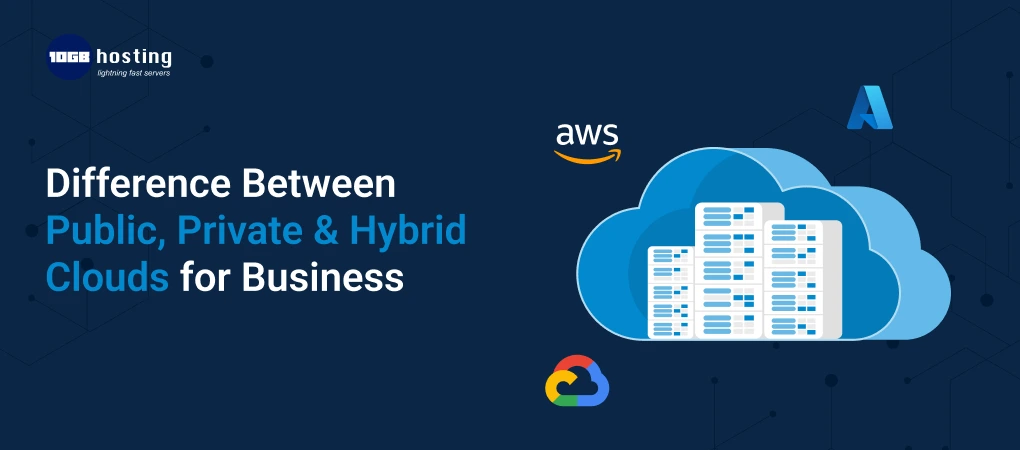
Some well-known public cloud providers are:
- AWS (Amazon Web Services)
- Microsoft Azure
- GCP, or Google Cloud Platform
How the Public Cloud Works
- The provider’s data centres house the infrastructure.
- Several consumers use the same physical resources.
- The internet gives you access.
- You just pay for what you use, thus the price is based on that.
Advantages of the Public Cloud
- Low initial cost—no need to buy hardware
- High scalability—scale up or down right away
- Quick deployment—get apps up and running quickly
- Managed infrastructure means less work for IT.
Limitations of Public Cloud
- Not as much influence over infrastructure
- Possible security risks for private information
- Performance may be different since resources are shared.
- Problems with following the rules in regulated industries
Example from the Real World
A new company that makes a mobile app uses AWS to host the app’s backend. When there are sales, traffic goes up, and the public cloud automatically scales up without the need to buy more servers.
What is a cloud that is private?
What does it mean?
A private cloud is a cloud system that only one company can use. You can host it on your own servers or in a third-party data centre, but you can’t share the resources with anyone else.
How a Private Cloud Works
- Infrastructure that is only for one business
- More options for customisation and control
- Managed by the company itself or by a service provider
- Access using safe connections or private networks
Pros and Cons of Private Cloud
- A lot of security and privacy
- Complete control over settings and data
- More consistent performance
- Easier to follow rules like HIPAA, GDPR, and others
Limitations
- Costs of setting up and keeping it up are higher
- Needs IT personnel with skills
- Not as scalable as the public cloud
- More time to deploy
An example from the real world
A bank uses a private cloud to keep track of customer transactions. A private cloud is necessary for following the rules and keeping data safe.
What is a cloud that is both public and private?
What it means
A hybrid cloud is a mix of public and private cloud environments that lets data and apps move across them without any problems.
How the Hybrid Cloud Works
- Sensitive information stays in the private cloud
- In the public cloud, workloads with changing demand run.
- Connected through safe networks
- Managed as a single system
Advantages of Hybrid Cloud
- The best of both worlds: security and growth
- Cost cutting
- Being able to change where work is done
- Better recovery from disasters
- Continuity in business
Limitations of Hybrid Cloud
- Architecture that is hard to understand
- Needs enhanced management tools
- Problems with integration
- More complicated operations
Example from the Real World
An eCommerce business keeps client information in a private cloud, but it uses a public cloud to accommodate traffic spikes during busy sales times.
Difference Between Public, Private, and Hybrid Clouds (Comparison Table)
| Feature | Public Cloud | Private Cloud | Hybrid Cloud |
| Ownership | Third-party provider | Single organization | Mixed |
| Cost | Low, pay-as-you-go | High upfront | Moderate |
| Scalability | Very high | Limited | High |
| Security | Standard | High | High |
| Control | Limited | Full | Partial |
| Ideal For | Startups, SMBs | Enterprises, regulated industries | Growing & large businesses |
1. How much it costs
- Public cloud: Lowest cost to start
- Private cloud: Most money spent
- Hybrid cloud: Spending that is balanced
2. Safety and Following the Rules
- A private cloud is great for storing sensitive data.
- The public cloud has shared security.
- With a hybrid cloud, you may choose where to store data.
3. Ability to change and grow
- The public cloud grows right away.
- Private clouds have restricted capacity.
- Hybrid cloud gives you flexible options.
4. Performance
- Private cloud offers reliable performance
- The performance of public clouds can change
- Hybrid cloud makes each workload run better
How to Pick the Best Cloud Model for Your Business
Think about these things one step at a time:
Step 1: Find out how sensitive your data is
- Very sensitive -> Private or Hybrid Cloud
- General workloads → Cloud for Everyone
Step 2: Look at the limits of your budget
- Not enough money → Public Cloud
- Long-term focus on ROI => Private or Hybrid Cloud
Step 3: Think about what you need to do to be compliant.
- Regulatory norms → Private or Hybrid Cloud
Step 4: Figure out how much scalability you need
- Unpredictable demand → Public or Hybrid Cloud
Step 5: Check out IT’s skills
- Small IT staff → Cloud for Everyone
- IT professionals with a lot of experience => Private or Hybrid Cloud
Why Choosing the Right Cloud Matters for Business Growth
Businesses can benefit from using the correct cloud model:
- Cut down on IT costs
- Make operations more efficient
- Make data safer
- Make innovation happen faster
- Help with digital transformation
A well-thought-out cloud strategy has a direct effect on how customers feel about your business, how reliable your systems are, and how big your organisation can become.
Cloud Use Cases for Different Industries
Startups and Small Businesses
- Mostly in the public cloud
- Cheap and easy to set up
Health care
- Cloud that is private or a mix of both
- Privacy of data and following the rules
Stores and online stores
- Cloud that is a mix
- Handles a lot of traffic well
Money and Banking
- Cloud for private use
- High security and following the rules
Common Questions (FAQs)
1. What is the fundamental difference between private, public, and hybrid clouds?
The primary differences are who owns it, how safe it is, how much it costs, and how easy it is to grow. Private clouds are for one person, while public clouds are for everyone. Hybrid clouds are a mix of the two.
2. Is a public cloud better than a hybrid cloud?
Businesses that require both security and flexibility should use a hybrid cloud, but it is harder to set up than a public cloud.
3. What are the pros and cons of private clouds?
The pros of private clouds are security and control, whereas the cons are greater costs and upkeep.
4. Can small firms adopt a hybrid cloud?
Yes, however hybrid cloud is usually better for firms that are expanding or are medium-sized and have a lot of different types of work to do.
5. What kind of cloud is best for keeping corporate data safe?
The most secure option is a private cloud, followed closely by a hybrid cloud.
In the end, which should you choose: public, private, or hybrid?
When it comes to cloud computing, there is no one right option for everyone. How much control, security, and flexibility your business really needs is what makes public, private, and hybrid clouds different.
- Pick the public cloud if you want something that is cheap and can grow with your needs.
- Pick a private cloud for safety and compliance.
- For flexibility and expansion, choose hybrid cloud.
Call to Action (CTA)
Are you ready to pick the appropriate cloud for your business?
Look at our cloud hosting options, compare plans, or get in touch with our specialists to create a cloud strategy that works for your business. For more useful cloud tips and technology tutorials, sign up for our blog.