Table of Contents
Why speed and stability still matter in the introduction
No matter how much cloud and virtualisation technologies improve, performance will always be a problem especially without the right infrastructure approach. Slow apps, unreliable response times, and ongoing resource constraints can quickly impact user experience and business outcomes, which is why many organizations are turning to bare metal virtualization to overcome these limitations and deliver consistent performance.
Traditional virtualisation gives you freedom, but it also adds extra work that can slow things down. This trade-off is not acceptable for workloads where performance is very important. This is where bare metal virtualisation really shines.
We’ll explain what bare metal virtualisation is, how it works, and most significantly, how it speeds up performance compared to regular virtual environments in this article.
What Bare Metal Virtualisation Is
What Does “Bare Metal” Mean in Real Life?
A bare metal server is a real system that is only for one customer. There is no hardware that is shared, and there are no workloads that are competing.
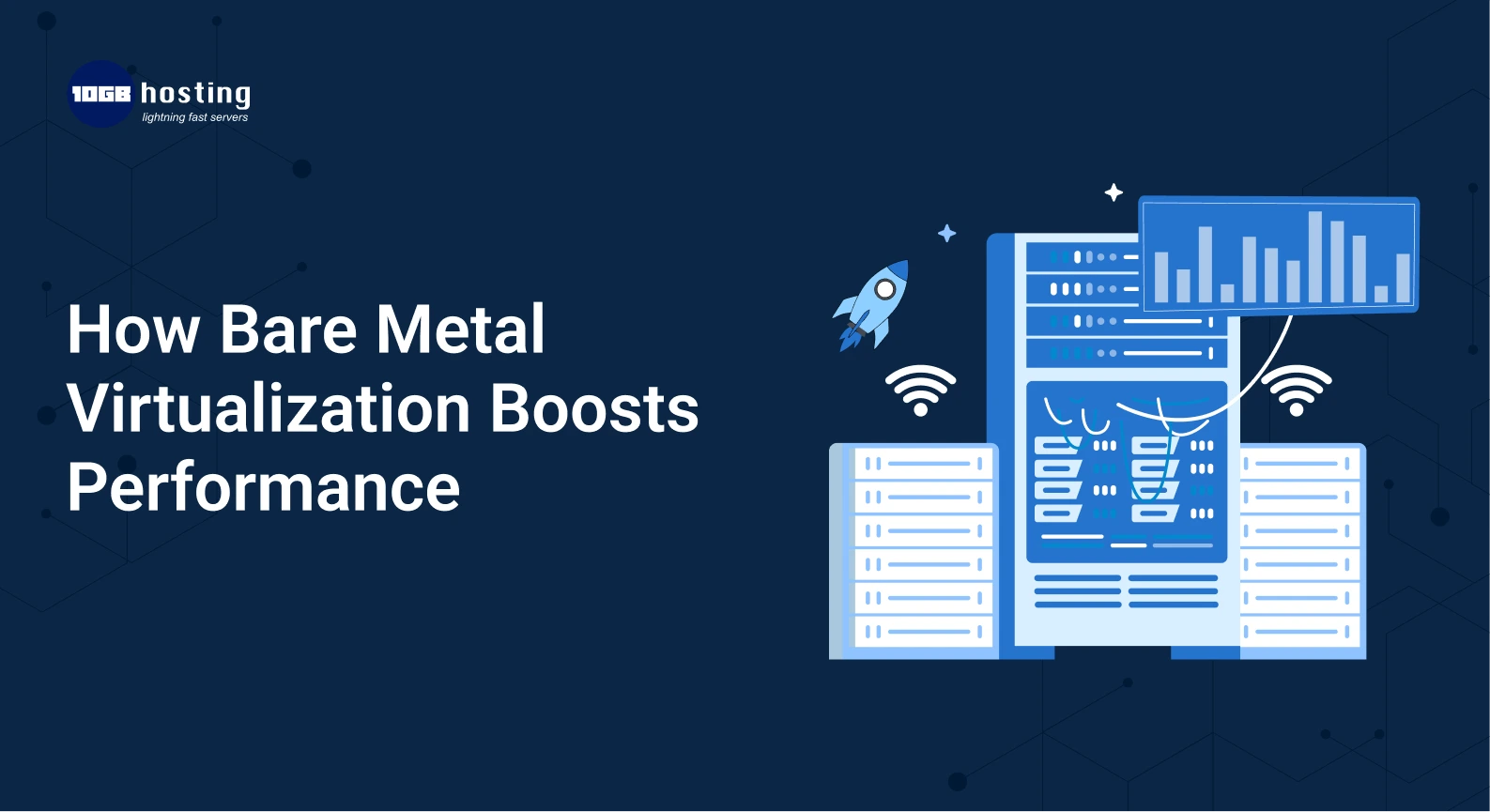
Bare metal virtualisation combines this dedicated hardware with virtualisation technology. This lets numerous virtual machines run directly on the server through a lightweight hypervisor that is installed on the hardware itself.
To put it simply:
- No one else can use the hardware resources.
- Virtual machines work more closely with the metal.
- There is very little loss of performance.
Virtualisation on bare metal vs. traditional virtualisation
This is what traditional virtualisation usually looks like:
Hardware → Host OS → Hypervisor → Virtual Machines
Bare metal virtualisation makes the stack easier:
Hardware → Hypervisor → Virtual Machines
One of the main benefits of bare metal virtualisation is that it speeds up processing and uses fewer resources by getting rid of the host operating system.
How Bare Metal Virtualisation Makes Things Work Better
1. Fewer layers mean faster execution
Every extra layer of software uses up CPU cycles and memory. With virtualisation on bare metal:
- There isn’t a host OS that runs background processes.
- Applications have access to more resources.
- Workloads run faster and more efficiently.
This directly leads to better performance.
2. Better Use of Physical Resources
Bare metal virtualisation lets you manage hardware allocation very precisely, like:
- Giving each CPU core its own job
- Setting aside fixed memory
- Putting storage and network I/O first
This level of management makes sure that workloads run smoothly, even when they are very busy.
3. Less Latency
When many systems fight for shared resources, latency is often added. Bare metal virtualisation helps to reduce this by:
- Getting rid of noisy neighbours
- Giving direct access to networking hardware
- Supporting setups with low latency
This is quite useful for apps that need to work in real time or process transactions.
4. Better stability when under load
Applications that run on bare metal virtualised environments are less prone to have unexpected decreases in performance. Because hardware is dedicated:
- Performance is still easy to forecast
- It’s easier to deal with resource increases.
- The system works more reliably
5. Improved performance of storage and networks
Bare metal virtualisation works with high-performance storage and networking technologies, which makes it possible to:
- Access to discs faster
- Less jitter on the network
- More data can be sent at once
This is very important for workloads that use a lot of data.
How to Use Bare Metal Virtualisation: A Step-by-Step Guide
Set up a separate physical server
Only one organisation can use the server.
Put on a Bare Metal Hypervisor
The hypervisor runs on the hardware itself, not on a host OS.
Make Virtual Machines
Virtual machines are given certain resources.
Make the best use of resources
Fine-tuning CPU, memory, storage, and networking for better performance.
Watch and Grow
Usage is watched so that resources can be changed as workloads grow.
Examples of Bare Metal Virtualisation in the Real World: E-Commerce Platforms
Online retailers get a lot of traffic during flash deals and busy times. Bare metal virtualisation makes sure that pages load quickly and that the checkout process is stable.
Services for gaming and streaming
It is important to have low latency and steady performance. Bare metal virtualisation lets you play games and watch videos without any problems.
Applications for Money
For trading platforms and payment systems to work, they need to be able to predict how well they will work. Bare metal virtualisation speeds up transactions and makes them more reliable.
Workloads for AI and analytics
Direct access to hardware is good for large datasets and machine learning models because it cuts down on processing time by a lot.
Bare Metal Virtualization’s Main Benefits
- Performance that is almost like native hardware
- Speed that is always the same and predictable
- More safety and privacy
- Using system resources effectively
- How flexible virtual machines are
- Less overhead for performance
These advantages of bare metal virtualisation make it a great solution for applications where performance is important.
Why Bare Metal Virtualisation Is Getting More Important
Today’s apps are bigger, faster, and more demanding than ever before. Customers want quick answers, and businesses can’t afford to have their systems go down or run slowly.
Bare metal virtualisation is helpful for businesses in the following ways:
- Make the customer experience better
- Get the most out of your hardware investment
- Support advanced tasks
- Don’t make trade-offs in performance
Questions That Are Often Asked (FAQ)
1. Is virtualisation on bare metal faster than regular virtualisation?
Yes. By getting rid of the host operating system, it cuts down on overhead and speeds things up a lot.
2. What kinds of workloads get the most out of it?
Databases, gaming servers, financial systems, AI/ML workloads, and apps that get a lot of traffic all benefit the most.
3. Does virtualisation on bare metal give up flexibility?
No. It keeps the flexibility of virtual machines while making them work better.
4. Is virtualisation on bare metal safe?
Yes. Dedicated hardware makes it easier to stay safe and lowers the likelihood of problems in shared environments.
5. Is bare metal virtualisation something that small enterprises can use?
Yes, for sure. Any company that has workloads that are important for performance can benefit.
Final Thoughts: Performance Without Giving Up
Businesses that need speed, reliability, and control can use bare metal virtualisation to solve their problems. It gets rid of the usual performance problems by combining dedicated hardware with virtualisation, and it keeps infrastructure flexible.
If your apps need to run well, bare metal virtualisation is something you should think about.
Call to Action
Want to make your apps run faster and more reliably?
Look into bare metal virtualisation solutions, think about your workloads, or talk to an infrastructure specialist to find out how bare metal virtualisation might improve your performance.
Start making things better today.
I can also do the following if you want:
- Make this work for a hosting firm website
- Make it better for Indian or worldwide SEO
- Make it easier for a help centre or landing page
- Change the tone to be more informal or more technical.